How to implement an AI chatbot in your hotel (step-by-step guide)
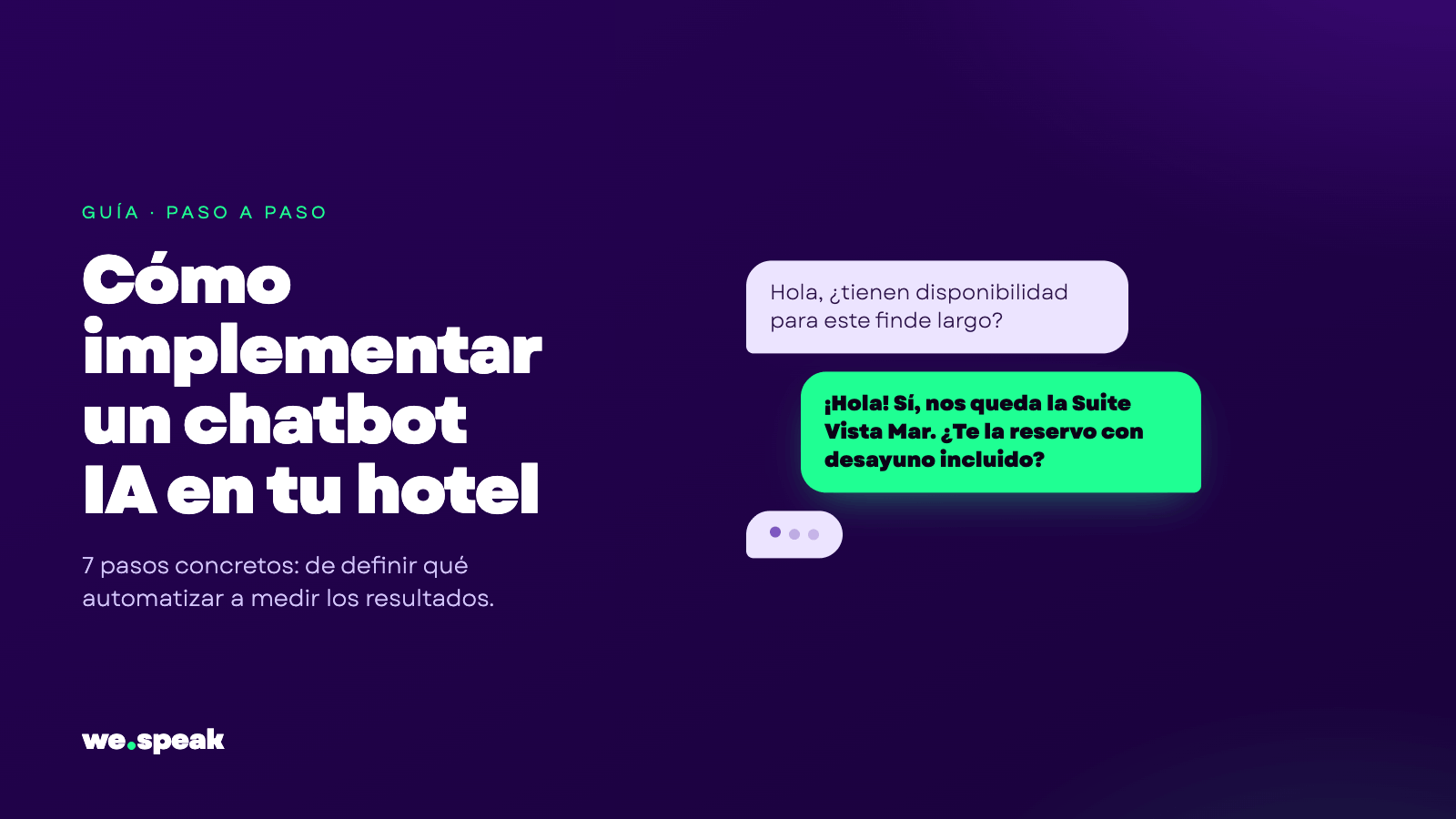
Implementing an AI chatbot in your hotel does not have to be complicated. With a clear method, you can go from idea to a working assistant in just a few weeks. In this guide we walk you through the 7 key steps to do it right from the start.
- Step 1. Define what to automate. Before choosing any tool, decide what you want the assistant to handle. The most common starting points are three fronts: bookings (availability inquiries and direct closing), frequently asked questions (hours, location, policies, wifi, parking) and upselling (early check-in, upgrades, extra services). Start with what consumes most of your time today.
- Step 2. Choose the right platform. Not all solutions are equal. Look for a platform built specifically for hospitality, one that understands guest language, integrates with your systems and is easy to manage without a technical team. WeSpeak, for example, is designed for hotels and connects service, bookings and sales in one place.
- Step 3. Connect your PMS and inventory. For the assistant to answer with real data (availability, rates, room types) it needs to be connected to your PMS or booking engine. This integration is what turns a chatbot that only informs into one that actually sells.
- Step 4. Set up the channels. Decide where the assistant will be available. Ideally cover the highest-contact points: your website, WhatsApp and Instagram. Having the same assistant across all channels ensures a consistent experience.
- Step 5. Train the assistant with your hotel's information. Load the real information: room descriptions, services, policies, FAQs, brand tone and special cases. The better it is fed, the more natural and accurate its answers will be. This step defines the quality of the result.
- Step 6. Test and adjust before launch. Before opening it to the public, run internal tests simulating real inquiries. Review answers, spot information gaps and fine-tune the tone. It is better to polish in private than to correct in front of a guest.
- Step 7. Measure your results. Once it is live, track key indicators: inquiries resolved without intervention, response time, bookings generated, upselling completed and guest satisfaction. The data will tell you what to adjust to improve month after month.
How long implementation takes (realistically)
With a well-designed platform, most hotels can have an assistant running within a range of 1 to 4 weeks. The first days go to configuration and connecting the PMS, then comes training with the hotel's information. Testing and adjustments usually take a few more days. The factor that most affects the timeline is not the technology, but how organized your hotel's information is at the start.
Common mistakes and how to avoid them
- Trying to automate everything at once. Start with the essentials and grow gradually.
- Not connecting the PMS. Without real data, the assistant informs but does not sell.
- Loading too little information. A poorly fed assistant gives vague answers and frustrates guests.
- Launching without testing. Skipping the adjustment phase shows immediately in the experience.
- Never reviewing again. A chatbot needs follow-up to improve over time.
Support and maintenance once it is live
An AI assistant is not a project that ends, it is a living tool. Once active, it is worth periodically reviewing conversations to detect new questions, updating rates and services when they change, and refining answers based on what guests ask. With WeSpeak, this maintenance is simple: you update the information from a dashboard and the assistant adjusts without reprogramming. The key is to treat the assistant as one more member of the team that improves with every interaction.
Discover the AI assistant for hotels by WeSpeak to increase your direct bookings and cut OTA commissions. See how to get started →
Frequently asked questions
How long does it take to implement an AI chatbot in a hotel?
With a well-designed platform, most hotels have the assistant running within 1 to 4 weeks. The timeline depends mostly on how organized your hotel's information is and on connecting the PMS, rather than on the technology itself.
Do I need technical skills to implement a chatbot?
Not necessarily. Hospitality-focused platforms like WeSpeak let you configure, train and update the assistant from a simple dashboard, with no coding. What matters most is having your hotel's information well organized.
Why is connecting the PMS to the chatbot so important?
Because connecting to the PMS or booking engine lets the assistant answer with real availability and rates. Without that integration the chatbot only informs; with it, it can close direct bookings and offer upselling using up-to-date data.
Want to increase your hotel's direct bookings?
Book a demo and we'll show you how WeSpeak turns guest inquiries into direct bookings.
Book a Demo